Sunday, August 16, 2020

Refugia, Refugios, for All Creatures

 BIG COIN SERIES: 25 CENT COIN (QUARTER - CARIBOU) - 2016 5 oz Fine ... 

God is our refuge and strength, a very present help in trouble.

Therefore will not we fear, though the earth be removed, 

and though the mountains be carried into the midst of the sea; 

Though the waters thereof roar and be troubled, 

though the mountains shake with the swelling thereof. Selah.

There is a river, the streams whereof shall make glad the city of God, 

the holy place of the tabernacles of the most High.

Psalm 46:1-4 - King James Version 

A dozen years ago I was so spiritually and psychologically exhausted after nearly 30 years of pastoral ministry that I needed some time away. I spent a couple of months on a remote farm at the end of a dirt road in the wilds north of Kingston. Ruth continued to work but would come up for three days every weekend. We both loved the solitude and remember this time fondly. We remain friends with the owners from whom we rented the old farmhouse who still live just down the road. 

Our son Isaac had walked the Camino pilgrimage route in France and Spain several years earlier and he told us about the refugios, the pilgrimage hostels in which he stayed with others making the 800-kilometre spiritual trek. I decided that this dead-end farm was actually a new beginning, a safe place, my refugio, and I wrote about it. 

So, I was intrigued by a CBC piece back in July about the work scientists are engaged in to document more than 12,000 species worldwide that are experiencing range shift — everything from fish to bees to caribou to grasses to berries to trees.

One of them, Gretta Peci  is a marine ecologist at the University of Tasmania and lead author on a recent study of range shift in the journal Science.  She says ""We're literally living through a redistribution of life on Earth, Even though this is my bread and butter that I work on, it really does blow my mind ... the extent of this phenomena." 

Ultimately, these species are seeking what scientists call climate change "refugia" — areas where they can survive at a time of environmental instability. 

What really caught my attention was the use of the term "refugia" to describe the geographical and climate areas where species and ecosystems can bide time while they adapt to change. Another way researchers describe this phenomena is "slow lanes" for survival, but refugia resonated with me. 

I'd never really considered that the refuge of Psalm 46 refers more broadly  to Creation, even though we usually assume this assurance is for humans. It's not just humans -- Groundlings -- who need places of refuge, and while refugia is used as a scientific term there is also a spiritual element to this, at least for me. All God's creatures are meant to have places of safety, not only in terms of protected areas such as parks and reserves, but as places where they can thrive as the climate crisis changes everything. 

Canada's boreal peatlands are one of the areas scientists are looking to preserve as the climate changes. (Submitted/ Michel Rapinski)


Ears to Hear

For Better Brain Health, Preserve Your Hearing - The New York Times

Gracia Lam

Said the little lamb to the shepherd boy 
Do you hear what I hear 
Ringing through the sky shepherd boy 
Do you hear what I hear 
A song, a song High above the trees 
With a voice as big as the sea 

12 
An ear that hears and an eye that sees.
    the Lord made them both.

Proverbs 20:12 The Hebrew Bible -- Robert Alter Translation

 Yesterday I was awake in the wee hours of the morning so didn't feel all that energetic as the day began. We decided to head out for a paddle just the same, and our kayaks were already on the roof of our vehicle. Because it was a bit breezy we chose a section of the Salmon River which is within the Tyendinaga Reserve, less than half an hour away.

 It is quite pretty but not our usual first choice because of the prospect of  noise. Highway 2 is nearby for a good portion of the stretch we paddle and Highway 401, Canada's busiest, is to the north. There is also a train trestle which sees frequent crossings. Yesterday, a Saturday morning, a din began just before 9:00 AM, an unexpected roar which we realized was the nearby motorsport park. There are a few cottages and a couple of farms along the river and we tried to imagine what it's like for these folk when the raceway is under full throttle. And what is it like for the creatures along the river, including the domestic animals? 

The paddle which we hoped would calm our spirits didn't. Yes, we saw turtles and blue herons and an osprey. The monarch butterflies and dragonflies were out in abundance. These were gifts from the Creator, but the assault on our ears made it difficult to be grateful for the experience. 

A couple of days ago I listened to a repeat broadcast of a CBC Radio The Current episode from February about the implications of our noisy environment and it includes a conversation with David Owen author of Volume Control: Hearing in a Deafening World:

"Especially since the Industrial Revolution, we've produced a lot of very loud sounds — sounds that we didn't really evolve to cope with — and it's taken a toll on our hearing. We evolved in a very different sound environment — thunderstorms and waterfalls and growling animals and things like that." 

11 books you heard about on CBC Radio this week | CBC Books

Alas, we spend a fair amount of time repeating ourselves to one another, a constant reminder of our failing hearing. Owen notes that we don't become deaf in our sixties, it is a gradual process which is the result of the endless assault on this marvelous sense.

 As I've noted before, Jesus said "let anyone with ears to hear listen." This is also a message of the prophets. Surely this includes our ability to hear the chorus of Creation in a time when we are drowning out the sounds of other creatures, to our physical, psychological, and spiritual peril. During the first couple of months of the pandemic people noted that the quiet, even in cities, was a gift.  Being able to hear should never be taken for granted. 

Thursday, August 13, 2020

Judy Chicago and Tikkun Olam

Greenpeace-Create-Art-For-Earth - Greenpeace USA

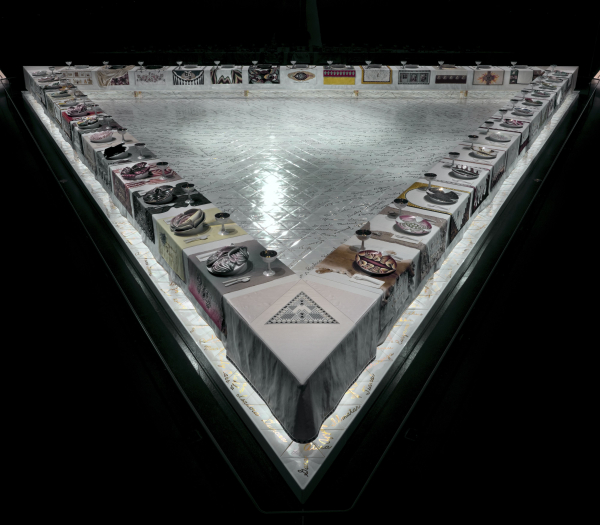
This morning I heard a great CBC Radio The Current interview with artist Judy Chicago. You might remember her from the late 1970's when she created the then controversial art installation called The Dinner Party. It was literally an elegant, triangular dinner table set as a banquet with 39 place settings to honour 39 famous women from history. It was controversial because the motifs were based on vulvar and butterfly forms -- you can figure that out what that means. Many galleries would not display this work, considering it vulgar, but it eventually toured the world.

Needless to say, The Dinner Party, offended the religious sensibilities of many. Chicago was raised in a loving, affirming non-religious family, even though her father came from a long line of Jewish rabbis. Eventually she reconnected with a form of Judaism which had room for her feminist sensibilities.

While in the interview she doesn't mention this, she does use a Jewish term "tikkun olam" or "mending the world" in relation to a a new project in collaboration with Jane Fonda, and Greenpeace and other institutions and galleries

It's called Create Art for the Earth and the website offers this explanation and exhortation: 

We call out to you to join us in creating art for the Earth; a global creative response to the climate crisis and the pandemic afflicting us. Create images that offer an alternative vision; one that protects the planet and all living creatures, one that promotes equity and justice for ALL.

Make art. Sing songs, create performances, recite poems. Do this alone or with your families on any kind of material that is available to you. Share what you create via the pathways we have established. Demonstrate the many ways that the arts can heal, lead, transform and make change.

I think this is a wonderful initiative which appeals to my spiritual and artistic sensibilities. I'm in awe of 81-year-old Chicago's energy and vision, and I can't help but believe that the Creator approves!

Judy Chicago (American, born 1939). The Dinner Party, 1974–79. Ceramic, porcelain, textile, 576 × 576 in. (1463 × 1463 cm). Brooklyn Museum; Gift of the Elizabeth A. Sackler Foundation, 2002.10. © Judy Chicago. (Photo: Donald Woodman)


Tuesday, August 11, 2020

A Pastor, a Forest, & a Murder Mystery

Rebecka Martinsson säsong 1 & 2 - Streama gratis - Streamcentrum.se

 We have been all over the map, or more accurately, all over the streaming services, during the COVID-19 isolation months as we searched for diversion from the end of the world as we know it. When a possible apocalypse looms just turn on the television.

One of the series we happened upon recently is Rebecka Martinsson, which as the name might suggest is Swedish. An edgy big city lawyer returns to her rural hometown for the funeral of a pastor who supported her in a turbulent earlier time in her life. This woman was an activist and rubbed a lot of people the wrong way, even as she was admired by others. Her death was deemed an accident until Rebecka begins to question the circumstances.

The unique plot feature is that the pastor had locked horns with members of the local hunting club ver the use of the church forest in which they had hunted for years. It got me thinking about the notion of a mainline European or North American congregations owning tracts of wooded land. My experience in ministry through nearly 40 years was with congregations which didn't have adequate parking, let alone a forest. In a day when many congregations are dissolving and selling property there isn't much chance that there will ever be a movement to own woods and forests as a Creation-care commitment, although I admire the Church Forests of Ethiopia.

Still, hey, a Lutheran pastor who might literally die for the trees? That's my kinda martyr!


Wednesday, August 5, 2020

Getting Outside & the Other Global Crisis


                           Salmon River June 1019


I heard this morning that sales of outdoor sporting equipment such as bicycles and kayaks is so strong this year that its a challenge to find it anywhere.  It seems that in our adjustment to the restrictions of COVID-19 we have shifted from in-store "retail therapy" to  physical activity and  outdoor "nature therapy." Obviously there is still a consumer component to this, but I've also seen that people are hauling bicycles out of storage to get outside, and lots more are going for walks, whether on urban trails or in the woods. Provincial parks are also seeing a boom this season, and both rentals and purchases of the dreaded RV are up.

We are avid outdoors folk, for care of body, mind, and spirit. When the pandemic changed everyone's lives back in March we carefully observed guidelines about contact with other persons but we live in an area where we can be in the natural world without much interaction with others . We are early birds so we get out when others are still in the land of nod. We are often on the water by 7:30 or 8:00 and this is an excellent form of physical distancing. We canoed a lot, beginning late in March, and are now kayaking more. We figure we've been paddling about 30 times this season and there are still several months before us. 

I wonder if this increase in outdoor exploration will make people more mindful of the other global crisis concerning climate. Our planet is changing for the worse because of human activity, and July was the hottest in more than 80 years in Southern Ontario. Strangely, this was the month when we felt most restricted and it was because of the heat. 

I celebrate that God's creatures, humans, are outside because it is a marvelous, diverse world which deserves our attention. And I hope that awe and wonder will lead to a change of heart and mind for us as individuals and as well as the governments we elect. 


Trent River, Lock 4, with son Isaac & the grandlads 

Monday, August 3, 2020

3 Billion Lost Creatures & the Integrity of Creation

Image

When unprecedented wildfires raged across Australia last year there was concern about destruction of property and loss of human life. In fact, several hundred people did perish but it was nothing compared to the holocaust of other creatures. The news reports showed us the cuddly and photogenic ones, the singed koalas and kangaroos. Then we heard that millions and as many as a billion animals died or were displaced by those fires, an unimaginable number. A year later we're told that the number is more like 3 billion, a staggering loss of diversity.

There is little doubt that human-made climate change was a major contributor to these massive fires, as is the case with both fire and flood in many parts of the planet which is our home. We simply have not faced the reality that our actions are changing the patterns of weather and threatening the fate of every living thing.

Tragically, religious fundamentalists who are often Youth Earth Creationists, rejecting evolution, are also climate emergency deniers, ignoring the scientific evidence all around them. \Humans have been users and abusers rather than care-full stewards of the Earth (a role mandated in scripture) for centuries. We know that species extinction brought about by humans is not new, although it is accelerating at an alarming rate.

The paintings in today's blog entry are by American artist, Walton Ford, after the style of J.J. Audubon, the 19th century naturalist and painter. The first shows the Great Auk which was once abundant on the Funk Islands off Newfoundland and hunted to extinction. The Thyacine, below, was theTasmanian Tiger or Wolf, thought to kill sheep and so wiped out by ranchers. Both species are gone forever and will be followed by many more as the mass extinction on Earth continues.

Do we have the will to repent, to alter our patterns of greed and ignorance, to honour Creation and Creator?


Image


Sunday, August 2, 2020

A Cosmic and Religious Experience

Full Sturgeon Moon - OFA

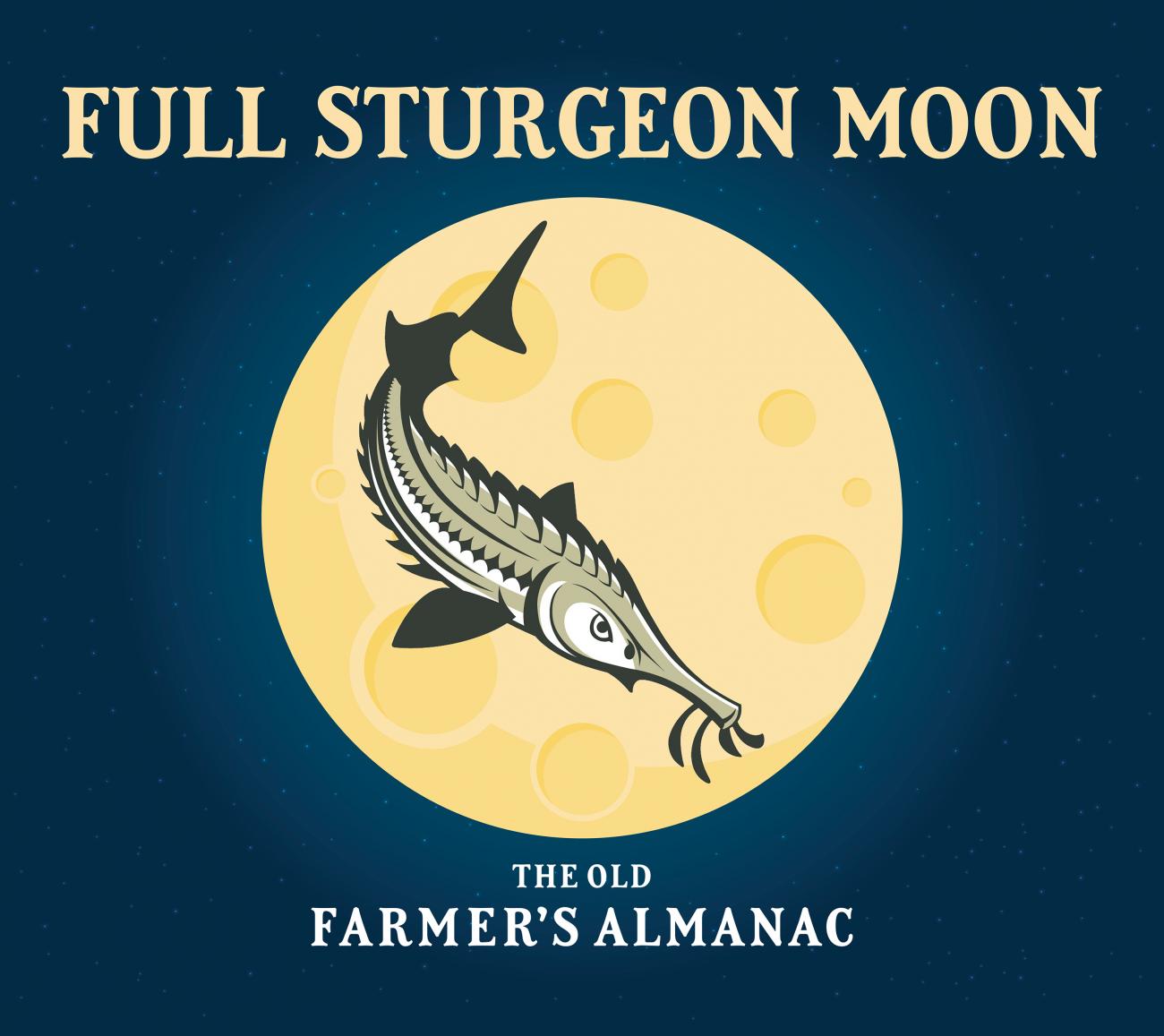
For the next couple of nights the August moon will appear full -- if we can see it through the cloud. Imagine, it has actually rained today! According to the Farmer's Almanac this is the Sturgeon Moon, a reference to the harvesting of once plentiful and now rare sturgeon fish by Indigenous peoples in an earlier time. It's likely to be orangey in colour, if visible, and will probably be clearest near noon tomorrow morning -- really. 

I love that there celestial sightings such as the phases of the moon have been auspicious for various reasons in different cultures for millenia. They mark key times for basic human survival but they have been observed for religious reasons. As I've written often enough before, both the Jewish Passover and Christian Easter are set according to the first full moon of the Spring Equinox. Jesus may have been visible to those who searched him out in the Garden of Gethsemane because he was bathed in moonlight. 

Image preview

A few days ago I came upon a card I had on my church study bulletin board for years. It's a woodcut by a Jewish printer from Holland published in 1707. It's called Blessing of the New Moon, a nod to the practice of the elders.

In our age of light pollution looking skyward to create a sense of solemnity and wonder may be even more important than ever, even though we may not realize what we're missing because we never see it.

While it's not likely you'll be doing any sturgeon fishing, look for that full moon over the next couple of days, and perhaps search out the Perseid Meteor Shower while you're at it. It could be a cosmic and religious experience.  


Paul Gauguin as Christ on the Mount of Olives  1889